 How-to
What Happens if You Over-Prune Shrubs?
Last Updated: October 24, 2026
Quick Summary
Over-pruning shrubs and you remove too much foliage at once, causing immediate stress, wilting, browning, disrupted flowering, and increased disease risk. The golden rule is never remove more than one-third of the shrub's total growth in a single season.
- Never remove more than one-third of a shrub's total canopy in one year
- Over-pruned shrubs show bare branches with leaves only at tips, exposed wood, and slow or no growth weeks after pruning
- Recovery takes one to two years for deciduous shrubs and three or more years for evergreens
- Stop pruning immediately and water deeply and consistently at approximately 2.5 cm per week to support recovery
- Evergreens like juniper do not regrow from bare branches, making them less forgiving than deciduous shrubs
Table of Contents
- When to Prune Shrubs and Why Timing Matters
- How Far Back to Prune Shrubs Without Causing Damage
- What Over-Pruning Does to Shrub Growth and Health
- Signs of Over-Pruned Shrubs and How to Spot Them
- How to Fix a Poorly Pruned Plant: Recovery Steps
- Common Pruning Mistakes That Lead to Over-Pruning
- Frequently Asked Questions
When to Prune Shrubs and Why Timing Matters
Prune at the wrong time and you can damage next season's flowers.
The best time to prune most shrubs is late winter or early spring, before new growth starts. This timing is generally recommended by horticultural experts for optimal plant recovery.
Summer pruning works for some shrubs but is riskier, since heat can stress the plant. Fall pruning is generally the worst time: new growth may start before the first frost, leaving tender shoots vulnerable to cold damage.
How Far Back to Prune Shrubs Without Causing Damage
The golden rule: never remove more than one-third of the shrub's total growth in a single season.
When you prune, follow these guidelines:
- Remove dead or diseased branches first
- Cut out crossing or rubbing branches
- Thin out crowded areas to improve air flow
Make cuts just above a healthy bud or branch junction, avoiding stubs or cuts too close to the main stem.
Species tolerance varies; boxwood handles moderate pruning well, while hydrangeas are more forgiving. However, all shrubs suffer if you remove more than one-third of their canopy at once.
What Over-Pruning Does to Shrub Growth and Health
Over-pruning creates immediate stress: the shrub loses photosynthetic capacity, growth slows or stops, and branches may die back completely.
Immediate stress and shock
Remove too much foliage at once, and the shrub enters shock, redirecting energy to survival rather than growth. Expect wilting, browning, or yellowing of remaining leaves within days or weeks. This shock response is the plant protecting itself, shutting down non-essential functions to keep the root system alive. That's why newly over-pruned shrubs often look worse before they get better.
Disrupted flowering and next season's buds
Many shrubs form flower buds months before they bloom. Spring-flowering shrubs set buds in late summer and fall; pruning them in winter or early spring removes those buds, meaning no flowers the following spring even if the plant survives. Summer-flowering shrubs form buds on new growth, so spring pruning is usually safe, but over-prune and the struggling plant may not produce enough new growth to flower.
Disease and fungal infection
Over-pruned shrubs have exposed wood and reduced leaf cover, inviting disease. Poor air circulation inside a dense, recovering shrub traps moisture between branches, letting spores settle and spread. Repeated heavy pruning can make shrubs too dense, reducing air circulation and increasing disease risk.
Over-pruning causes several interconnected problems that affect a shrub's immediate health and long-term survival.
| Problem | Cause | Effect |
|---|---|---|
| Immediate stress and shock | Removing too much foliage at once | Wilting, browning, yellowing within days or weeks |
| Disrupted flowering | Cutting off flower buds formed months earlier | No flowers the following spring or season |
| Disease and fungal infection | Exposed wood and reduced leaf cover | Powdery mildew, leaf spot, canker |
| Poor air circulation | Dense recovery growth traps moisture | Spores settle and spread between branches |
Signs of Over-Pruned Shrubs and How to Spot Them
An over-pruned shrub shows clear warning signs, and spotting them early improves recovery odds. However, wilting, browning, and dieback can stem from over-pruning, ordinary pruning shock, or disease, and the response differs in each case.
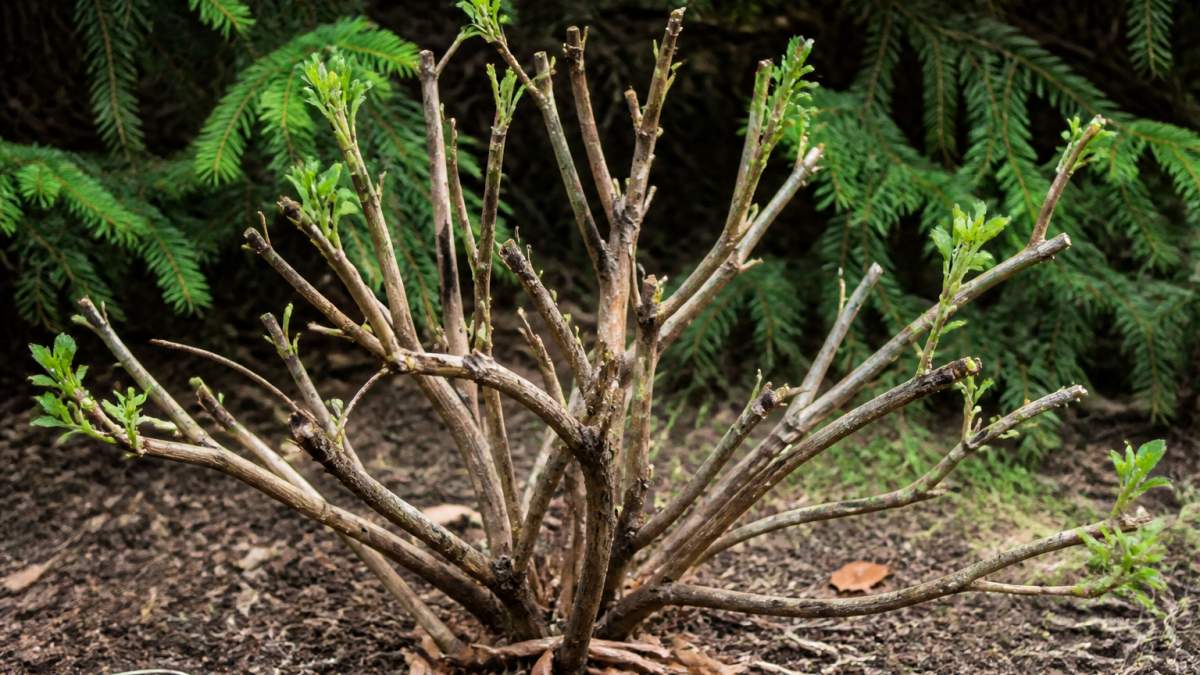
What over-pruning looks like
Look for these indicators, especially in combination:
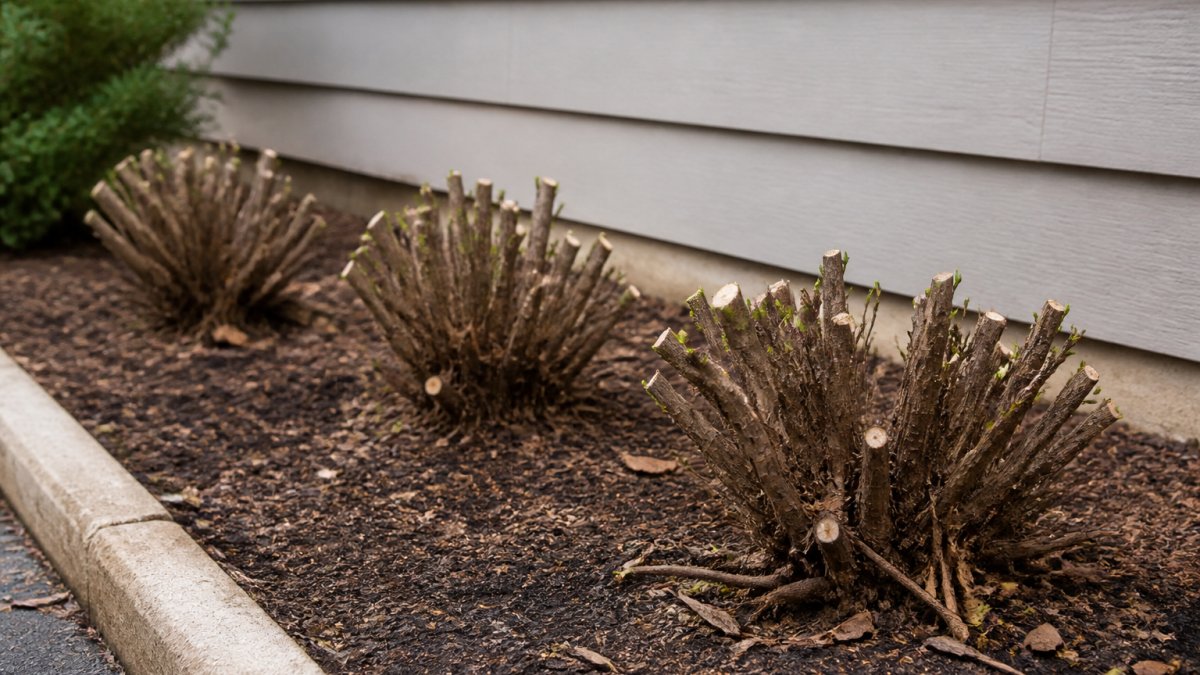
- Bare branches with leaves only at the tips (leggy appearance)
- Large areas of exposed wood with no foliage
- Dieback or browning on cut ends
A severely over-pruned shrub may look nearly dead, mostly brown wood, little green, and leafless lower branches, because too much canopy was removed for the plant to support what's left.
Over-pruning vs. pruning shock vs. disease
The distinction matters because the response differs:
- Over-pruning is a structural problem: too much live growth removed at once. The pattern is usually uniform, with bare lower branches, growth concentrated at the tips, and damage spread evenly. Symptoms appear within days to a few weeks of the cut.
- Pruning shock is a temporary stress response, even when the amount removed was within reason. It often shows as wilting or slight leaf drop in the days after pruning, then stabilizes, and the shrub usually recovers on its own within a few weeks with proper watering.
- Disease typically shows spotting, discoloration, or damage in random patches rather than a uniform pattern. Look for leaf spots with defined edges, powdery coatings, cankers (sunken dead areas on stems), or dieback spreading from a specific point rather than following the pruning cuts.
A useful diagnostic: if damage tracks the pruning, bare where you cut, growth where you didn't, over-pruning is likely. Patches unrelated to cuts suggest disease or pests. Brief wilting that stabilized was likely shock.
Timeline: when symptoms appear
Knowing when to expect symptoms helps you avoid misreading normal recovery as decline:
- Days 1-7: Wilting, slight leaf yellowing, or leaf drop. This is often shock or the immediate stress response, not necessarily permanent damage.
- Weeks 2-4: Browning on cut ends, dieback on branches that can't be supported, and the leggy pattern becoming obvious. This is when over-pruning is usually confirmed.
- Weeks 4-8: New growth should begin from dormant buds. If it doesn't, the shrub is in trouble.
When the signs point to serious damage
Some symptoms suggest the shrub may not recover without intervention or replacement:
- No new growth at all by midsummer
- Dieback that continues to spread down branches week after week
- Bark that peels or slips easily from the wood
If you see these, test a few branches by scratching the bark: green tissue underneath means the branch is alive; brown, dry tissue means it isn't. If most branches test brown, replacement is likely the better choice. If some are still green, there is still a chance; give the shrub the recovery steps above and reassess at the end of the season.
How to Fix a Poorly Pruned Plant: Recovery Steps
Recovery is possible but takes time, and the steps you take immediately after over-pruning matter. It depends on shrub type, age, and health, and how much live growth was removed; a boxwood that lost half its canopy differs from a lilac that lost a third.
Step-by-step recovery plan
Treat the first growing season as a recovery period, not a shaping period:
- Stop cutting. Put the pruners away. Every remaining leaf is producing energy the shrub needs to rebuild. Further pruning, even "tidying," sets recovery back.
- Water deeply and consistently. Aim for about 2.5 cm per week at the base, including rainfall; increase to approximately 3.8 cm in hot, dry weather. Water in the morning so foliage dries before evening, and avoid overhead watering, which encourages fungal problems on exposed wood.
- Mulch, but don't mound. Apply 5-7.5 cm of organic mulch (shredded bark, compost, or leaf mold) around the root zone, a few inches away from the trunk or stems, to moderate soil temperature and moisture in the first summer after heavy pruning.
- Skip fertilizer for the first season. Do not fertilize right after over-pruning. Nitrogen pushes weak, tender growth that can't handle stress. If the shrub shows active new growth by midsummer, a light application of a balanced fertilizer the following spring is reasonable. Never fertilize a shrub that is still declining.
- Monitor new growth weekly. Look for buds swelling on older wood, especially lower on the branches, the clearest sign of recovery. Growth only at the tips suggests the plant is still running on stored energy.
- Resist the urge to reshape. Wait at least one full growing season before any corrective pruning. In year two, remove only dead wood and clearly crossing branches. Full structural restoration may take three seasons.
Species-specific tolerance and limits
Not all shrubs respond the same way to heavy pruning. A few patterns are worth knowing:
- Deciduous shrubs that bloom on new wood (panicle hydrangea, potentilla, spirea, rose of Sharon) are among the most forgiving. They regrow from dormant buds along the stems and often flower again the same season or the next.
- Deciduous shrubs that bloom on old wood (lilac, forsythia, mock orange, bigleaf hydrangea) recover vegetatively but may skip a bloom cycle or two. The plant survives; the flowers are what you lose.
- Evergreens (boxwood, yew, juniper, cedar) are less forgiving. Yew and boxwood can regenerate from older wood, but juniper and most conifers do not push new growth from bare branches. If you cut a juniper back into bare wood, that branch will not regrow. This is the single most important species distinction for over-pruning risk.
A useful rule: the more live growth removed and the older the wood cut into, the longer the recovery and the lower the odds of full restoration.
Timeline and expectations for recovery
Most over-pruned deciduous shrubs need one to two years to fully bounce back; evergreens can take three or more. Here's what to expect:
- Weeks 1-4: The plant may look worse as damage becomes visible. Leaves may yellow or drop. This is normal; the shrub is shedding foliage it can no longer support.
- Month 2-3: New growth should start appearing, usually from dormant buds lower on the branches. On deciduous shrubs, look for small green buds along older stems.
- Month 4-6: Growth accelerates as temperatures warm. Shrubs that bloom on new wood may flower late in the season.
When to call a professional or replace the shrub
Some situations warrant an expert assessment rather than a wait-and-see approach:
- The shrub is large, mature, or valuable, and you're unsure whether it will survive.
- You see repeated dieback, branches that die back further each season rather than stabilizing.
- The shrub is in a prominent location and its appearance matters while it recovers.
A certified arborist or experienced horticulturist can assess whether the damage is recoverable and recommend a path forward, often patience, sometimes replacement.
Replace the shrub if it shows no signs of recovery after one full growing season, or if the damage is so severe that recovery would take three or more years and the plant's role in the landscape can be filled faster by a new specimen.
Common Pruning Mistakes That Lead to Over-Pruning
Most over-pruning happens because of one simple mistake: not understanding how much you're actually removing.
Topping is the biggest culprit.
Over-shearing happens when you use hedge shears on every surface of the shrub.
Ignoring the one-third rule is the fastest path to trouble.
The good news: these mistakes are preventable.
Over-pruning shrubs is a common problem, but it doesn't have to be permanent. For expert assistance with your landscaping needs, consider reaching out to Bigfoot landscaping & contracting at https://www.instagram.com/bigfoot_landc?igsi=dDV6eGJ2dTFrczc4.
Frequently Asked Questions
Can an over-pruned shrub grow back?
Yes, most shrubs can recover from over-pruning, but recovery takes time and depends on how severely the plant was cut. Pruning actually encourages new growth around the pruned areas. However, severely over-pruned shrubs may take 1-3 years to regain a full, healthy shape. Some species tolerate heavy cutting better than others. If more than 50% of the plant's foliage is removed at once, recovery is slower and the shrub may remain weakened during that period.
What are the immediate signs that a shrub has been over-pruned?
Immediate signs include bare, exposed wood with few or no leaves remaining, wilting or browning foliage on remaining branches, and visible dieback within days or weeks. Over-pruned shrubs often develop leggy stems with lower growth removed, leaving an unbalanced, spindly appearance. If the shrub was cut into old wood (branches thicker than a pencil with no green), new growth may not emerge from those areas, and the plant will look permanently damaged in those spots.
When is the best time to prune shrubs to avoid over-pruning damage?
Prune most shrubs in late winter or early spring, just before new growth begins. Spring pruning allows the plant to recover quickly during its active growing season. Avoid heavy pruning in late summer or fall, as this stimulates tender new growth that frost can kill. For flowering shrubs, prune immediately after blooming to avoid removing next season's flower buds. Never prune during dormancy in deep winter or during drought stress, as the plant has fewer resources to heal.
How do I help a shrub recover after over-pruning?
Start by watering deeply and regularly to reduce plant stress, and apply mulch around the base to retain moisture and regulate soil temperature. Avoid fertilizing immediately after severe pruning; wait until new growth appears, then use a balanced fertilizer to support recovery. Prune out any dead or diseased wood, and do not prune again until the shrub shows healthy new growth. Be patient: recovery typically takes several months to a year for moderate over-pruning, and up to 3 years for severe damage. If the shrub shows no signs of life after one full growing season, it may need to be replaced.