 How-to
How to Choose Mulch for Landscaping: 7 Key Factors
Quick Summary
To choose mulch, first identify the site and its main job, such as weed suppression, moisture retention, soil building, or appearance. Then match a material to that job and check your budget and maintenance needs. Most beds need two to three inches of depth.
- Identify the site first: sun or shade, slope, wind, and bed type eliminate options quickly.
- Pick one primary job: weed suppression, moisture retention, soil building, or appearance.
- Coarse shredded hardwood or pine bark suits weed suppression, while shredded leaves or straw hold moisture.
- Apply most landscape beds two to three inches deep, keeping mulch several inches clear of stems and trunks.
- Refresh organic mulch every one to two years, since it thins out and weeds return through worn spots.
Table of Contents
- Start With What the Mulch Needs to Do
- Organic vs. Inorganic Mulch: The Core Trade-Off
- Types of Mulch for Garden Beds
- Mulch vs. Compost: Which One Belongs in Your Beds
- Choosing the Best Mulch for Trees and Shrubs
- How Deep to Apply Mulch and How Much You Need
- Mulch Mistakes That Can Hurt Your Plants
- Booking Your Mulching Job With Bigfoot
- Frequently Asked Questions
Start With What the Mulch Needs to Do
Last Updated: November 21, 2026
When you choose mulch for landscaping, start with a simple question: what do you need it to do? Most homeowners pick by color alone, then wonder why beds look tired by late summer.
Rather than ranking those goals in your head, work through a short decision sequence. It turns a vague preference into a specific material and depth.
Step 1: Identify the site. Is the bed sunny or shaded, flat or sloped, windy or sheltered? Is it a planting bed, a vegetable patch, a path, or a tree ring? Site conditions eliminate options faster than anything else.
Step 2: Name the primary job. Pick one: weed suppression, moisture retention, soil building, or appearance. A shaded perennial border under mature maples usually prioritizes soil building and moisture; a sunny driveway bed prioritizes weed suppression and heat tolerance; a front-entry bed prioritizes appearance.
Step 3: Match the job to a material family.
- Weed suppression first: coarse shredded hardwood, pine bark nuggets, or a double layer of newspaper under bark. Coarse, thick pieces block light and knit together.
- Moisture retention first: shredded hardwood, shredded leaves, or straw. These hold water at the surface and slow evaporation.
- Soil building first: compost, shredded leaves, or aged bark fines. These break down and feed the soil food web.
- Appearance first: colored hardwood, pine bark nuggets, or contrasting gravel. Match tone to brick, siding, and plant foliage.
Step 4: Check the constraints. Budget, local availability, delivery access, and maintenance appetite all narrow the list. Bulk material is cheaper per cubic yard but needs a driveway or tarp drop; bagged material costs more but suits small jobs.
Step 5: Set depth and refresh interval. Two to three inches suits most beds. Coarse bark can go slightly deeper; fine compost should stay shallower. Plan to top up annually or every second year, and note that fresh, unaged wood chips can temporarily tie up nitrogen as they decompose.
Write down your site, primary job, and one or two constraints before you shop. That short list will narrow the aisle or the bulk order to two or three real candidates, and it will keep you from buying on color alone.
Organic vs. Inorganic Mulch: The Core Trade-Off
Organic mulches break down over time and feed the soil, while inorganic mulches such as rubber, gravel or landscape fabric stay largely unchanged. That single difference drives most of the decision. Organic options improve soil structure and need replenishing every one to two years. Inorganic options last far longer but do nothing for soil health and can heat up in full sun.
For most garden beds, we recommend organic mulch because the soil benefits compound over seasons. Inorganic mulch makes more sense in high-traffic paths, around fire-prone structures, or in spaces where you never plant. Many properties use both, with organic mulch in planting beds and gravel or stone in walkways.
Watch out: buying the cheapest bulk mulch without checking its age. Fresh wood chips can temporarily tie up nitrogen in the soil as they decompose, which can leave nearby plants looking pale. Ask your supplier how long the material has been aged.
Pros and Cons of Common Organic Options
- Shredded hardwood: Long-lasting, attractive color, good for beds. It can float away on sloped sites.
- Pine bark nuggets: Coarse, slow to decompose, good for shrub beds and drainage. They are pricier and can look heavy in small gardens.
- Straw: Light, inexpensive, suits vegetable gardens. It breaks down quickly and can carry weed seed.
- Compost: Feeds the soil directly, but it is not a strong weed barrier on its own.
Types of Mulch for Garden Beds
For perennial and mixed beds, shredded hardwood and fine bark work well because they knit together and stay put. Apply them in a layer about two to three inches deep, keeping the material a few inches away from plant stems and tree trunks to prevent rot.
Vegetable beds call for a different approach. Straw or shredded leaves keep soil moist and suppress weeds, and they are easy to pull back when you plant. Replenish them through the season as they settle.
Colored mulches are popular for their appearance, but the dye is usually the only difference from natural wood. Choose a shade that complements your brick or siding, and avoid anything that looks artificially bright, which can clash with the plants.
Mulch vs. Compost: Which One Belongs in Your Beds
Mulch and compost are often confused, but when you choose mulch for your beds, know that they do different jobs. Mulch sits on top of the soil to slow evaporation and block weeds. Compost is worked into the soil, or spread thinly on top, to add nutrients and improve texture.
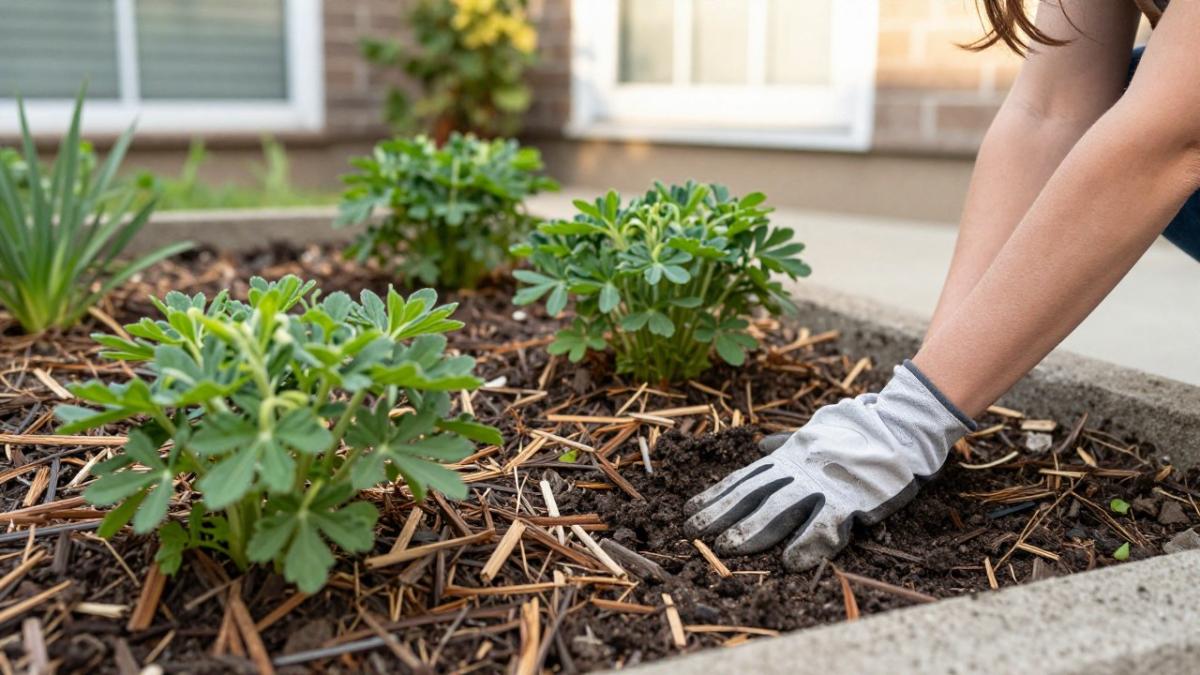
In raised beds, a practical approach is to add compost to the soil at planting time and then cover it with a mulch layer. The compost feeds the plants while the mulch keeps moisture in and weeds down. If you have only one to spend your effort on, start with the mulch, since surface cover prevents more problems than compost alone.
Choosing the Best Mulch for Trees and Shrubs
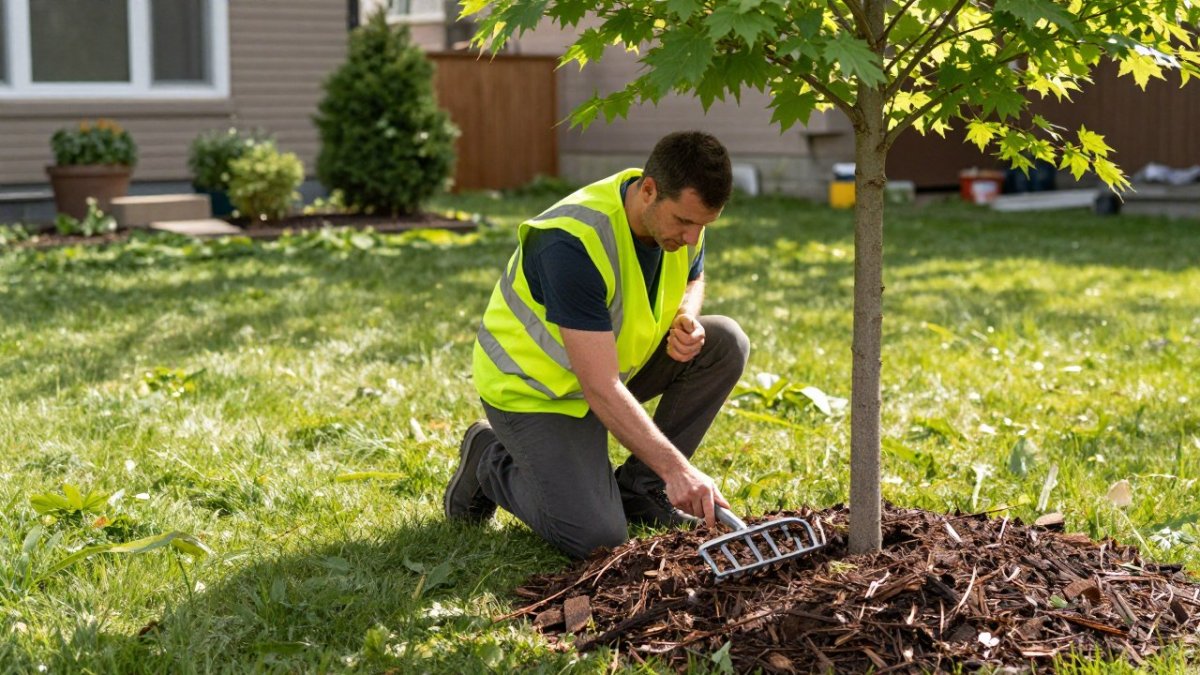
Trees and shrubs need mulch kept well back from the trunk or stems. A circle of mulch extending outward to the drip line, with a bare zone of several inches at the base, prevents bark rot and discourages rodents from nesting against the trunk.
Coarse pine bark or shredded hardwood suits most trees and shrubs because the larger pieces resist washing away and let air reach the roots. Avoid piling mulch into a mound, which traps moisture and invites decay. For newly planted trees, a wide, shallow ring of mulch helps the root zone stay evenly moist during the first few seasons.
How Deep to Apply Mulch and How Much You Need
Depth is where most mulch projects go wrong. Too thin and weeds push through; too thick and roots suffocate. For most landscape beds, two to three inches is the target. Fine materials such as compost or shredded leaves should sit at the shallow end, around two inches, because they pack down and can mat. Coarse bark and nuggets can go to three inches because air and water move through the larger pieces.
Special cases change the number:
- Newly planted trees and shrubs: a wide, shallow ring of two to three inches, kept several inches clear of the trunk.
- Vegetable beds: one to two inches of straw or shredded leaves, easy to pull back at planting.
- Slopes: slightly deeper coarse mulch plus edging, because material creeps downhill.
- Paths and non-bed areas: gravel or stone at two to four inches over a compacted base, not organic mulch.
- Poorly drained soil: stay at the shallow end and choose a coarse material that lets air through.
Calculate quantity in four steps.
- Measure each bed's length and width in feet and multiply to get square feet. Break irregular beds into rectangles and add them.
- Convert your target depth to feet: two inches is about 0.17 feet, three inches about 0.25 feet.
- Multiply square feet by depth in feet to get cubic feet.
- Divide cubic feet by 27 to get cubic yards, then add about 10 percent for settling and waste.
Worked example: a bed 20 feet long by 10 feet wide is 200 square feet. At three inches (0.25 feet) that is 50 cubic feet, or about 1.85 cubic yards. Add 10 percent and you need roughly 2 cubic yards.
Prepare the site before spreading. Remove existing weeds, especially deep-rooted perennials, and rough up the soil surface so water does not run off. Edge the bed so mulch stays put. Water the bed first if the soil is dry, then spread mulch evenly with a rake, feathering it thinner near plant crowns and thicker between plants. Keep a clear collar of several inches around every stem and trunk.
Watch out: ordering bulk mulch by the bag-equivalent without converting units. Bulk is sold by the cubic yard, bagged by the cubic foot, and mixing the two leads to short or excess deliveries. Confirm whether your supplier quotes delivered or picked up, and ask about delivery access before the truck arrives.
Depth and quantity depend on the bed type, so the article's targets are summarised below.
| Situation | Target depth | Note |
|---|---|---|
| Most landscape beds | 2-3 inches | Standard starting point |
| Fine material (compost, shredded leaves) | About 2 inches | Packs down and can mat |
| Coarse bark or nuggets | Up to 3 inches | Air and water move through |
| Newly planted trees and shrubs | 2-3 inches | Wide ring, clear of trunk |
| Vegetable beds (straw, leaves) | 1-2 inches | Easy to pull back at planting |
| Paths (gravel or stone) | 2-4 inches | Over a compacted base, not organic |
Mulch Mistakes That Can Hurt Your Plants
The most common error is piling mulch against plant stems and tree trunks. This holds moisture against bark, invites rot and insects, and can girdle young trees. Keep a clear collar at the base of every plant.
Other frequent mistakes include:
- Applying too thick: Layers over four inches restrict oxygen and water to the roots.
- Using fresh, unaged wood chips near sensitive plants: Decomposition can temporarily pull nitrogen from the soil.
- Ignoring slopes: Lightweight mulch washes downhill, so choose heavier material or add edging.
- Forgetting to refresh: Organic mulch thins out over time, and weeds return through worn spots.
Watch out: placing landscape fabric under organic mulch on a planting bed. The fabric eventually traps the decomposing material on top, and roots can circle on the surface above it.
Booking Your Mulching Job With Bigfoot
If you would rather skip the sourcing, measuring and spreading, Bigfoot landscaping & contracting can help with mulching as part of your property care. For current pricing and availability, visit our website to request a free estimate.
Frequently Asked Questions
What type of mulch is best for landscaping?
There is no single best mulch. Shredded hardwood and double-ground bark are popular for garden beds because they hold their colour, suppress weeds and break down slowly enough to last a season or more. Pine bark nuggets suit larger landscape areas and slopes where wind could move finer material. Straw works well in vegetable gardens but blows around more easily. Match the mulch to the bed, the plants and how much maintenance you want to do each year.
Should I use mulch or compost in garden beds?
Most gardeners use both, but for different jobs. Mulch sits on top of the soil to suppress weeds, hold moisture and moderate temperature. Compost is usually worked into the soil to add nutrients and improve structure. You can spread a thin layer of compost and cover it with mulch, which gives you the feeding benefit of compost and the protection of mulch in one step.
How deep should mulch be in garden beds?
Aim for about 5 to 8 centimetres (2 to 3 inches) of organic mulch in garden beds. Fine mulches pack down more and should be kept on the lighter side, while coarse bark can go a little deeper. Keep mulch pulled back a few centimetres from plant stems and tree trunks, since piling it against the base can cause rot and attract pests. Top up the layer each spring as it breaks down.
Is wood mulch suitable around trees and shrubs?
Yes, wood-based mulch is generally a good choice around trees and shrubs. Shredded bark or wood chips help keep roots cool and moist and reduce competition from weeds. Spread it in a wide ring out to the drip line rather than a tight circle, and keep it off the trunk. Avoid fresh wood chips mixed into the root zone of plants that are sensitive to nitrogen tie-up, and use aged material where possible.